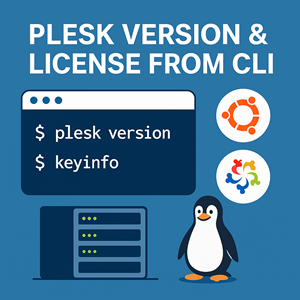
If you manage Plesk servers, there are two things you’re constantly asked for: What version is installed? and Which license/edition is this server running? Here’s a fast, copy‑paste friendly guide for Linux and Windows.
TL;DR
- Version:
plesk version - Full license details:
plesk bin keyinfo --list - Edition (by domain limit):
- 10 domains → Web Admin Edition
- 30 domains → Web Pro Edition
- Unlimited → Web Host Edition
Prerequisites
- SSH or console access on Linux; RDP or local access on Windows.
- Run commands as root/administrator (or with
sudo).
Ubuntu vs. AlmaLinux — What’s Different?
Most commands are identical across modern Ubuntu (20.04/22.04/24.04) and AlmaLinux/Rocky/CentOS Stream (8/9). The key differences are the package manager and a couple of optional verification commands.
| Task | Ubuntu | AlmaLinux / Rocky |
|---|---|---|
| Show panel version | plesk version |
plesk version |
| Panel binary path | /usr/sbin/plesk |
/usr/sbin/plesk |
| Package query (Plesk core) | dpkg -s plesk-core | grep -i '^Version' |
rpm -q psa |
| Check installer version | plesk installer --version |
plesk installer --version |
| System service check* | systemctl status psa |
systemctl status psa |
| License registry fallback | /etc/sw/keys/registry.xml |
/etc/sw/keys/registry.xml |
*Service checks aren’t required to read version/license, but they’re useful when Plesk isn’t responding.
Tip: If
pleskisn’t in yourPATH, call it with the absolute path:/usr/sbin/plesk.
Check the Plesk Version
Linux
|
1 2 3 4 5 6 |
# Standard plesk version # Absolute path (if $PATH isn’t set) /usr/sbin/plesk version |
Typical output:
|
1 2 3 4 |
Product version: Plesk Obsidian 18.0.58 Build date: 2025/09/17 OS version: Ubuntu 22.04 x86_64 |
Windows (PowerShell or CMD)
|
1 2 |
"%plesk_bin%\plesk.exe" version |
Bonus checks (optional):
|
1 2 3 4 5 6 7 8 9 10 |
# Installer version (not the same as the control panel version) plesk installer --version # Package versions # RPM (CentOS/Rocky/Alma) rpm -q psa # DEB (Debian/Ubuntu) dpkg -s plesk-core | grep -i '^Version' |
Check License Details & Identify Edition
Linux
|
1 2 3 4 5 |
# Dump all installed license properties plesk bin keyinfo --list # (alias) plesk bin keyinfo -l |
Look for fields such as key ID, expiration, add‑ons, and limits (e.g., domains, mailboxes, resellers).
Windows
|
1 2 |
plesk bin\keyinfo.exe --list |
Map License Limits to Edition
If the explicit edition name isn’t obvious in the output, use the domain limit as a proxy:
- 10 domains → Web Admin Edition
- 30 domains → Web Pro Edition
- Unlimited → Web Host Edition
Note: Providers sometimes bundle add‑ons or custom SKUs. If your output differs, the domain limit still reliably indicates the base edition.
Handy One‑Liners (Linux)
|
1 2 3 4 5 6 7 8 9 10 11 12 13 14 15 |
# Show edition-ish hints (name/edition/domain limit lines) plesk bin keyinfo -l | egrep -i 'name|edition|domain|limit' # Extract just the license key ID plesk bin keyinfo -l | grep -i plesk_key_id # Show the expiration date plesk bin keyinfo -l | egrep -i 'expir|valid|expire' # Quick, human-friendly summary (best effort) (echo -n 'Plesk: '; plesk version | head -n1 | cut -d: -f2-) && \ (echo -n 'License ID: '; plesk bin keyinfo -l | awk -F': ' '/plesk_key_id/{print $2;exit}') && \ (echo -n 'Domain limit: '; plesk bin keyinfo -l | awk -F': ' '/domain.*limit|domains/{print $2;exit}') && \ (echo -n 'Expires: '; plesk bin keyinfo -l | awk -F': ' '/expir/{print $2;exit}') |
Troubleshooting
- Command not found: Use the absolute path
/usr/sbin/pleskor ensure/usr/sbinis in yourPATH. - Insufficient privileges: Run as
rootor prependsudo. - License looks outdated/invalid after IP change or upgrade:
123456# Validate current license (exit 0 = valid)plesk bin license -c# Re-fetch from Plesk’s licensing serversplesk bin license --retrieve - Plesk services down but you need the key number:
123# Fallback: read the key registry directly (Linux)grep "<name>PLSK" /etc/sw/keys/registry.xml
FAQ
Q: Where is the edition name printed exactly?
A: It’s not always labeled as “Edition.” Many keys show a product name or description and always include limits. The domain limit is the most consistent indicator.
Q: Does the installer version equal the panel version?
A: No. plesk installer --version is for the installer component, useful for debugging but not for the panel’s version string.
Q: Can I script this for inventory?
A: Yes—wrap the one‑liner summary in a loop across hosts and collect outputs to a central log.
Wrap‑Up
To recap:
plesk versiontells you exactly which Plesk build you’re on.plesk bin keyinfo --listreveals the license details.- The domain limit cleanly maps to Web Admin (10), Web Pro (30), or Web Host (Unlimited).
If you use Plesk at scale and want a turnkey inventory script that emails a daily CSV of versions/editions, drop us a line—Reliable Penguin can help automate it.