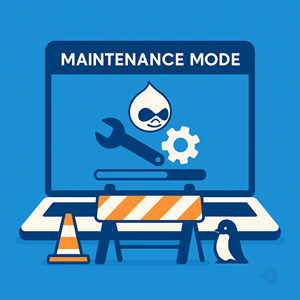
When you run a Drupal site, there will come a day when you need to make changes without visitors seeing a half-updated page or a broken checkout. That’s where maintenance mode comes in. In this narrative guide, we’ll explain who should use it, what it actually does, why it matters for your business, and how to enable or disable it safely across Drupal versions. We’ll also share practical tips from the trenches—because we’ve rescued more late-night deployments than we can count.
The Story: Why maintenance mode exists
Imagine it’s Friday evening, traffic is steady, and a critical security update just dropped. You need to deploy now—but you don’t want users hitting odd errors while caches rebuild or entities update. Maintenance mode gives you a clean, controlled experience: visitors see a friendly message, while admins (with the right permission) can still access the site to perform updates. Less chaos, more control.
Who should use maintenance mode?
- Site owners & editors: Planning content or structural changes that could confuse visitors while they’re live.
- Developers & DevOps: Applying database updates, module/theme upgrades, Drupal core updates, or large configuration deployments.
- Agencies/managers: Coordinating scheduled downtime windows with stakeholders and support teams.
Tip: You can grant the “Bypass maintenance mode” permission to specific roles so your team can work while the site is closed to the public.
What maintenance mode actually does
- Shows anonymous visitors a maintenance page instead of your normal site.
- Keeps access open for users who have bypass maintenance permission (usually admins).
- Reduces risk of data inconsistency during updates (e.g., mid-migration visits).
- Communicates a clear, helpful message so users know it’s temporary.
It does not pause cron, stop external traffic at the edge (CDN), or magically refresh third‑party caches. You still need to handle those parts.
Why you should use it (business reasons)
- Protects user trust: Better to show a professional message than a 500 error.
- Avoids broken flows: Especially important for eCommerce, logins, forms, and editors working in parallel.
- Eases rollbacks: Locking the public side reduces noisy errors during deployments.
- SEO sanity: A short, well-communicated maintenance window is typically safer than serving broken content. (For long windows, consider edge controls and search engine guidance—see Best Practices.)
How to use maintenance mode (Drupal 8/9/10)
Option A: Admin UI (fast and friendly)
- Go to Configuration → Development → Maintenance mode (
/admin/config/development/maintenance). - Check Put site into maintenance mode.
- Customize the message.
- Save configuration.
- When you’re done, uncheck it and save again.
Option B: Drush (repeatable and scriptable)
Enable
|
1 2 3 |
drush sset system.maintenance_mode 1 drush cr |
Disable
|
1 2 3 |
drush sset system.maintenance_mode 0 drush cr |
Optional: Set a clear message (Drush)
|
1 2 3 |
drush cset system.maintenance message "We’re performing scheduled maintenance and will be back shortly." -y drush cr |
How to use maintenance mode (Drupal 7)
Admin UI
- Go to Configuration → Development → Maintenance mode (
/admin/config/development/maintenance). - Check/uncheck Put site into maintenance mode.
- Set the message.
- Save configuration.
Drush
Enable
|
1 2 3 |
drush vset --always-set maintenance_mode 1 drush cc all |
Disable
|
1 2 3 |
drush vset --always-set maintenance_mode 0 drush cc all |
Locked out? (SQL fallback)
If you can’t access admin or Drush (for example, after moving environments), you can flip the switch via SQL. Use with care and always back up the database first.
Drupal 8/9/10 (key_value → state)
Enable
|
1 2 3 4 |
INSERT INTO key_value (collection, name, value) VALUES ('state','system.maintenance_mode','i:1;') ON DUPLICATE KEY UPDATE value='i:1;'; |
Disable
|
1 2 3 4 |
INSERT INTO key_value (collection, name, value) VALUES ('state','system.maintenance_mode','i:0;') ON DUPLICATE KEY UPDATE value='i:0;'; |
Then clear caches (e.g., drush cr).
Drupal 7 (variable table)
Enable
|
1 2 |
UPDATE variable SET value='i:1;' WHERE name='maintenance_mode'; |
Disable
|
1 2 |
UPDATE variable SET value='i:0;' WHERE name='maintenance_mode'; |
Then drush cc all.
Best practices from Reliable Penguin
- Communicate early: Post a banner or notice a day ahead if the window is planned. Include the date/time and timezone.
- Write a human message: Avoid generic “Site offline.” Say what’s happening and when you’ll be back. (See templates below.)
- Purge caches in order: After enabling maintenance mode, clear Drupal caches, then your CDN (Cloudflare, Fastly) and any reverse proxy (Varnish). Do the same when disabling.
- Consider edge blocking: For high-traffic sites, temporarily enable an edge maintenance page (at CDN/WAF) to protect origin capacity during heavy updates.
- Keep it short: Maintenance windows should be as brief as possible. Practice the runbook.
- Have a rollback: Define the “if not healthy by T+N minutes, revert” plan.
- Monitor live: Track application logs, 5xx rate, and homepage TTFB while you work.
- SEO note: For very short windows, serving a maintenance page is fine. For long windows, consider returning a 503 with a
Retry-Afterheader at the edge to guide crawlers.
Handy message templates
Short planned window
We’re performing scheduled maintenance on {Date} {Time Zone}. We’ll be back in about {Duration}. Thanks for your patience!
Urgent security patch
We’re applying a critical security update and will return shortly. Thank you for your understanding as we keep your data safe.
Busy eCommerce
Our store is temporarily offline for upgrades. Please check back in {X minutes}. Your cart will be right where you left it.
A simple runbook you can reuse
- Announce the window (internal + public).
- Enable maintenance mode (UI or Drush).
- Purge Drupal caches, then edge/proxy caches.
- Deploy code and run DB updates (e.g.,
drush updb), config imports, and rebuild caches. - Sanity test critical paths (homepage, login, checkout/forms).
- Disable maintenance mode.
- Purge edge/proxy caches again.
- Monitor for regressions and roll back if needed.
Quick reference (copy/paste)
Drupal 8/9/10
Enable:
|
1 2 |
drush sset system.maintenance_mode 1 && drush cr |
Disable:
|
1 2 |
drush sset system.maintenance_mode 0 && drush cr |
Drupal 7
Enable:
|
1 2 |
drush vset --always-set maintenance_mode 1 && drush cc all |
Disable:
|
1 2 |
drush vset --always-set maintenance_mode 0 && drush cc all |
Need help?
If you’d like Reliable Penguin to plan or execute your maintenance window (including backups, rollbacks, and after-action reports), reach out. We’re happy to help keep your Drupal site fast, secure, and calm during changes.