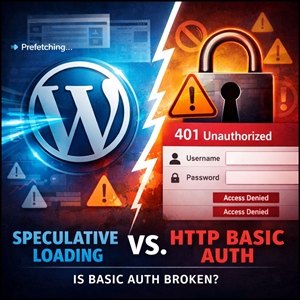
WordPress 6.8 introduced Speculative Loading — a performance feature that encourages modern browsers to prefetch likely-next pages so navigation feels faster.
On public sites, this can be a win.
On HTTP Basic Auth–protected environments (staging, preview, maintenance, internal demos), it can be a problem: background requests can trigger 401 Unauthorized responses in ways that interfere with normal, user-initiated navigation.
This article explains what’s happening, what you can do about it, and why this may be a turning point for using HTTP Basic Auth as a simple staging gate.
What the breakage looks like
After upgrading to WordPress 6.8, a Basic Auth–protected site may start doing one or more of the following:
- Clicking internal links results in 401 Unauthorized even after credentials were entered.
- The browser repeatedly prompts for credentials (or never prompts and just fails).
- Pages load inconsistently: the first request works, later navigations don’t.
- In DevTools → Network, you’ll notice requests firing before you click.
If you’ve ever said “Basic Auth always worked fine on staging and now it’s flaky,” this is likely what you’re seeing.
What’s actually happening
HTTP Basic Auth was designed in an era when most requests were the direct result of a user action (clicking a link, loading a page, submitting a form).
Modern performance techniques break that assumption.
With WordPress 6.8 Speculative Loading enabled, browsers may attempt background requests to pages you might visit next. Those requests are not necessarily treated the same as a normal top-level navigation. In real-world conditions this can produce a cascade of issues:
- The speculative request gets a 401.
- That 401 may be cached or reused in ways that poison the real navigation.
- The user experiences repeated prompts, failed navigations, or inconsistent “sometimes it works” behavior.
The net result is that background prefetch behavior and full-site Basic Auth don’t reliably coexist.
The obvious fix: disable Speculative Loading (with an important caveat)
In theory, disabling WordPress’s Speculative Loading should prevent WordPress-driven speculative requests and remove the trigger.
In practice, real-world testing shows this is not always a complete fix.
Why it may still fail even after disabling in WordPress
Even after WordPress stops outputting speculation rules, you can still see intermittent or persistent Basic Auth breakage due to one or more of the following:
- Browser caching behaviors (including back/forward cache) replaying or reusing unauthenticated responses.
- Browser heuristics or extensions that prefetch independently of WordPress.
- CDNs / reverse proxies caching 401 responses or mishandling
Varybehavior. - Differences in how credentials are applied to top-level navigation vs. background or speculative requests.
Takeaway: Disabling Speculative Loading can reduce or eliminate the issue in many environments — but it is not guaranteed to restore Basic Auth reliability everywhere.
How to disable Speculative Loading in WordPress 6.8+
If you want to try the simplest mitigation first, disable WordPress’s Speculative Loading output.
Tip: Put this in an MU plugin (recommended) so it doesn’t disappear when you switch themes.
|
1 2 3 4 5 6 |
<?php /** * Disable Speculative Loading (WordPress 6.8+). */ add_filter( 'wp_speculation_rules_configuration', '__return_null' ); |
Disable it only on non-production environments
If you’d rather keep it in production and disable it on staging/dev:
|
1 2 3 4 5 6 7 8 |
<?php add_filter( 'wp_speculation_rules_configuration', function( $config ) { if ( defined( 'WP_ENVIRONMENT_TYPE' ) && WP_ENVIRONMENT_TYPE !== 'production' ) { return null; } return $config; } ); |
Disable it only when Basic Auth is detected (best-effort)
This can work when PHP can see the auth headers (note: some proxies strip these unless configured to pass them through):
|
1 2 3 4 5 6 7 8 |
<?php add_filter( 'wp_speculation_rules_configuration', function( $config ) { if ( ! empty( $_SERVER['PHP_AUTH_USER'] ) || ! empty( $_SERVER['HTTP_AUTHORIZATION'] ) ) { return null; } return $config; } ); |
Troubleshooting: if disabling Speculative Loading didn’t fix it
If the behavior persists, you’re likely hitting one of the “real world” factors described earlier.
Work through these checks:
- Test with a clean browser profile (no extensions).
- Clear site data (cookies + storage) and cache for the staging domain.
- Bypass your CDN/proxy temporarily and hit the origin directly.
- Confirm 401 responses are not cached by your edge layer:
- Ensure your CDN/proxy is not caching
401responses. - Confirm appropriate
Cache-Controlheaders. - If you rely on
Authorization, verify correctVaryhandling.
- Ensure your CDN/proxy is not caching
- Test multiple browsers (Chrome vs Firefox vs Safari) to determine if it’s engine-specific.
If you can’t get back to stable behavior, consider that the gating method — not just WordPress — may need to change.
A bigger takeaway: this may be the beginning of the end for HTTP Basic Auth as “staging protection”
HTTP Basic Auth still “works” in the narrow protocol sense.
But as browsers and platforms lean harder into prefetching, prerendering, caching, and speculative requests, Basic Auth becomes operationally fragile when used as a full-site gate.
If your organization depends on Basic Auth for staging, the WordPress 6.8 Speculative Loading incident is a warning sign: the modern web is increasingly hostile to the assumption that every request is user-initiated and credentialed the same way.
That doesn’t mean Basic Auth is dead everywhere — but it’s becoming harder to treat it as a set-and-forget solution.
What to use instead of HTTP Basic Auth
If you need reliable staging protection going forward, these options tend to be more resilient:
1) Identity-aware access proxy (recommended)
Examples: Cloudflare Access, Google IAP, Azure AD App Proxy, Okta, etc.
- Strong authentication flows, MFA support, and good auditing
- Designed to handle modern browsing behavior cleanly
2) Private access (VPN / overlay network)
Examples: WireGuard, Tailscale, ZeroTier
- Extremely reliable gating
- Great for internal teams and agencies
3) IP allowlisting
- Simple and effective for small teams
- Less friendly for mobile/remote work and dynamic IPs
4) Application-layer login gate
- WordPress-level gating (or a lightweight “maintenance gate”)
- Can be a good fit when you need to protect dynamic pages without edge auth
Bottom line
- WordPress 6.8 Speculative Loading can expose long-standing cracks in full-site HTTP Basic Auth.
- Disabling Speculative Loading is worth trying — but it’s not guaranteed to restore stability.
- If your staging access needs to be dependable, now is a good time to plan a move away from HTTP Basic Auth toward modern access controls.