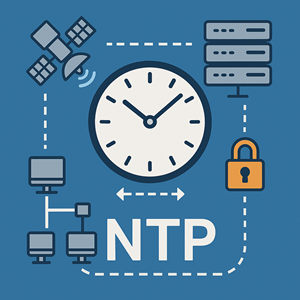
Time is a hidden dependency in nearly every system you run. From TLS handshakes and Kerberos tickets to log correlation, backups, CI pipelines, and database replication, things quietly assume the clock is correct. The Network Time Protocol (NTP) is the decades‑old, battle‑tested mechanism we use to keep distributed clocks in rough agreement with reality.
This article offers a practical, narrative tour of NTP: what it is, how it works, the history that led to modern NTP, and why it matters. It’s aimed at engineers and operators who want a solid mental model without drowning in academic formalisms.
What is NTP?
NTP is a protocol for synchronizing the clocks of computers over packet networks. It estimates the difference (offset) between your system clock and coordinated universal time (UTC) as kept by trusted servers, then continually adjusts your local clock’s frequency and phase to minimize that difference while filtering out network jitter and bad data. NTP typically runs over UDP port 123 and is designed to converge gradually and stably, not instantly, because abrupt jumps in time can break software.
In practice, NTP is more than a wire protocol. It’s a family of algorithms and implementations that:
- Select good time sources from a set of candidates.
- Filter and combine measurements to reduce noise.
- Discipline the local oscillator so your clock stays accurate even between server polls.
Modern Linux distros ship with one or more NTP clients/daemons: chronyd (Chrony), ntpd/ntpsec, systemd-timesyncd, and OpenNTPD. They all speak the NTP protocol but differ in defaults, security posture, and control tooling.
A Short History of Time (Sync)
Long before NTP, computers kept time parochially. Minicomputers read quartz clocks; mainframes were disciplined by operators; labs compared time by dial‑up modems or radio receivers tuned to WWV/WWVH (U.S. national time signals on shortwave) and DCF77/MSF in Europe. As the ARPANET matured in the late 1970s, researchers began experimenting with packet‑based timekeeping so distributed systems could agree on “now” without human intervention.
The breakthrough work came from David L. Mills and collaborators at the University of Delaware. Early testbeds in the late 1970s/early 1980s used so‑called “Fuzzball” routers and ad‑hoc algorithms that evolved into the Network Time Protocol. The first NTP specification appeared as RFC 958 in 1985 (often associated with NTPv1). It showed that you could infer clock offset and network delay from a 4‑timestamp exchange and then gently steer a software clock toward UTC.
Protocol evolution. NTP’s story since then is steady refinement rather than revolutions:
- NTPv2 (RFC 1059/1119, 1988–1990) clarified the on‑wire format and formalized the stratum model and clock selection ideas already in use on the early Internet.
- NTPv3 (RFC 1305, 1992) consolidated years of operational lessons, describing clustering/selection algorithms, clock filters, and control loops that made the protocol robust on noisy, asymmetric networks.
- Simple NTP (SNTP, RFC 2030 → RFC 4330) defined a lightweight subset for devices that didn’t need full selection/discipline logic, paving the way for embedded clients and simple OS services.
- NTPv4 (RFC 5905, 2010) became the de‑facto baseline for modern deployments; it preserved wire compatibility while improving dispersions, reference‑ID handling, and scalability.
- Network Time Security (NTS, RFC 8915, 2020) introduced a modern, deployable way to authenticate NTP using TLS‑bootstrapped cookies, finally solving the Internet‑scale key‑management problem that Autokey never quite cracked.
Operational ecosystem. In parallel, the surrounding ecosystem broadened dramatically:
- Public time services. National metrology institutes exposed authenticated feeds; vendors shipped GPS/GLONASS reference clocks; and in 2003 the volunteer‑driven pool.ntp.org project made “good enough, highly available” time accessible to everyone by load‑balancing thousands of community servers behind regional hostnames.
- Implementations diversify. The classic reference implementation
ntpdremained ubiquitous, while alternatives focused on security and operability: OpenNTPD (OpenBSD, simplicity and privilege‑separation, circa 2004), chrony (fast convergence, excellent holdover on unstable links; started in the late 1990s and widely adopted by RHEL/CentOS/Fedora), and later NTPsec (a security‑hardened, trimmed fork of ntpd). - Security hardening. High‑profile reflection/amplification attacks around 2013–2014 (notably via the legacy
monlistcommand) pushed the community to ship safer defaults, rate‑limit responses, and retire brittle features. That era was a turning point: time servers were no longer “background appliances” but Internet‑exposed services requiring active stewardship. NTS emerged later as the cryptographic answer to spoofing and on‑path tampering.
Leap seconds, GPS, and “smear” time. UTC’s occasional leap seconds repeatedly surfaced edge cases in distributed software. The widely publicized 2012 leap second incident caused kernel and JVM hiccups across large fleets. Operators responded with coordinated playbooks, and some providers (notably hyper‑scalers) adopted leap‑smearing—stretching seconds around the event so clocks remain monotonic. Meanwhile, the 1999 and 2019 GPS week‑rollover events reminded everyone that upstream time sources have their own quirks that ripple into NTP if not carefully handled.
Coexisting with PTP. In 2002 (revised 2008), the IEEE published Precision Time Protocol (PTP, 1588), enabling sub‑microsecond synchronization on LANs with hardware timestamping. Rather than displacing NTP, PTP complemented it: many organizations use NTP to feed datacenter grandmasters and rely on PTP where microseconds matter.
By the early 2020s, the modern picture had settled: NTPv4 on the wire, NTS for authentication where security matters, chrony/ntpd/ntpsec/openntpd as the common daemons, and a healthy mix of public providers (Google, Cloudflare, Netnod, national labs) alongside enterprise stratum‑1s fed by GNSS. What began as a research project to tame clocks on a fledgling network became a quiet pillar of today’s Internet.
How NTP Works (Conceptual Model)
At its core, NTP measures round‑trip time (RTT) to a server, estimates one‑way delay, and infers your clock’s offset. Each exchange includes four timestamps: when the client sent the request, when the server received it, when the server sent the reply, and when the client received it. From these, the client computes an offset and a dispersion (its uncertainty). Because one‑way network paths aren’t symmetric and jitter is real, a single sample is noisy. NTP therefore collects samples over time, applies a clock filter to prefer low‑delay measurements, and runs clustering algorithms to discard outliers.
Rather than stepping the clock frequently, NTP disciplines your local oscillator. If your quartz crystal runs slightly fast or slow, the daemon learns a frequency correction (in parts per million) and continuously slews time so applications see a smooth, monotonic timeline. If the offset is wildly wrong at startup (for example, after being powered off for weeks), the client may perform one initial “step” to jump into the right ballpark and then return to gentle slewing.
Strata and Reference Clocks
NTP arranges time sources into “strata.” Stratum 0 devices are the sources of truth—GPS receivers, atomic clocks, or national time standards. Servers directly connected to them are stratum 1; their clients are stratum 2, and so on. Lower is better, but not always more reliable; a well‑run stratum‑2 with multiple upstreams can beat a flaky stratum‑1.
Clients usually consult several servers across different networks. The daemon selects a subset that appear consistent with each other and your local oscillator, then combines them to produce a best estimate. This diversity is crucial for resilience against faulty servers and asymmetric routing.
Security and NTS
Classic NTP includes symmetric keys and the now‑deprecated Autokey system, both awkward to manage at Internet scale. Network Time Security (NTS) fixes this by using TLS for bootstrapping and cookies for lightweight, replay‑resistant authentication of subsequent NTP packets. With NTS, clients can verify they’re talking to the intended servers, greatly reducing spoofing risk. Adoption is accelerating, and many public providers now offer NTS endpoints.
Why Correct Time Matters
Synchronized clocks turn out to be a prerequisite, not a nicety. Security protocols like TLS, SAML, OIDC, and Kerberos rely on bounded clock skew for certificate validity and ticket lifetimes. Distributed systems use timestamps to order events, advance leases, and resolve conflicts. Monitoring and forensics depend on aligned logs. Build and deployment systems compare modification times. Database replication, object storage lifecycles, token expiration, and even cron/systemd timers assume a sane notion of “now.” If clocks drift far enough, subtle heisenbugs become outages.
NTP in the Real World
On Linux servers, you’ll most often encounter three approaches:
Chrony (chronyd) is favored by many distros (notably RHEL) for its fast startup convergence, robustness on intermittently connected hosts and virtual machines, and straightforward tooling via chronyc. Chrony models frequency well and maintains good accuracy even with variable network conditions.
Classic NTP (ntpd or ntpsec) remains ubiquitous. It’s mature and richly documented. NTPsec focuses on code hardening and cleanup while keeping user‑visible behavior similar. Tooling includes ntpq and ntpstat.
systemd-timesyncd provides a minimal Simple NTP (SNTP) client built into systemd. It’s lightweight and easy to enable but intentionally limited: no server mode, no complex selection logic, and historically weaker holdover performance. It’s fine for desktops and simple containers; most servers benefit from Chrony or NTP(sec).
OpenNTPD is popular in BSD circles and focuses on simplicity and sane defaults over precision tuning.
Operational Tips (Explained)
Run more than one server. NTP’s strength is in comparing and combining multiple independent sources. Two servers can only tell you they disagree; three or four let you triangulate.
Prefer regional pools or reputable providers over hard‑coding a single hostname. The pool rotates volunteers and offers geographic diversity. Enterprises should consider at least one in‑house server that itself syncs upstream to multiple sources.
If your threat model includes on‑path attackers, enable NTS. It adds negligible operational cost today and meaningfully improves integrity against spoofing and replay.
Avoid exposing your clients or servers unnecessarily to the whole Internet. Rate‑limit responses, disable monlist on legacy daemons, and use firewalls to control who can query or peer with you.
Virtual machines and cloud instances can drift more than bare metal due to shared resources and suspended state. Chrony’s design handles this well. Give time tooling a few minutes after boot before judging accuracy.
Monitor it. Track offset, jitter, and reachability in your observability stack. Sudden changes often indicate upstream issues, routing changes, or leap‑second handling events.
Leap Seconds and Timescales
UTC includes occasional leap seconds to keep civil time aligned with Earth’s rotation. Because inserting a 61‑second minute can confuse software, providers adopt different strategies: some step the extra second at midnight UTC, while others “smear” it by lengthening seconds over a window so the day remains monotonic. If you mix sources with different strategies, small disagreements appear around the event. The solution is consistency—pick providers with the same policy for your fleet.
NTP vs. PTP: Choosing the Right Tool
If you need tens of microseconds or better across a LAN—industrial control, market data capture, or telecom backhaul—PTP with hardware timestamping is the right approach. For general systems, NTP’s millisecond‑level accuracy is excellent, scalable, and easy to operate across the public Internet. Many environments use both: PTP for in‑rack precision, NTP for everything else and as a stratum‑source for PTP grandmasters.
Conclusion
Time synchronization is foundational infrastructure. NTP’s longevity comes from conservative algorithms, wide deployment, and operational flexibility—from tiny embedded clients to national time services. For most engineers, the recipe is straightforward: deploy Chrony or NTPsec, point at multiple reputable servers (ideally with NTS), monitor a few key metrics, and keep policies consistent across your fleet. Do that, and “what time is it?” can safely fade into the background while everything else just works.